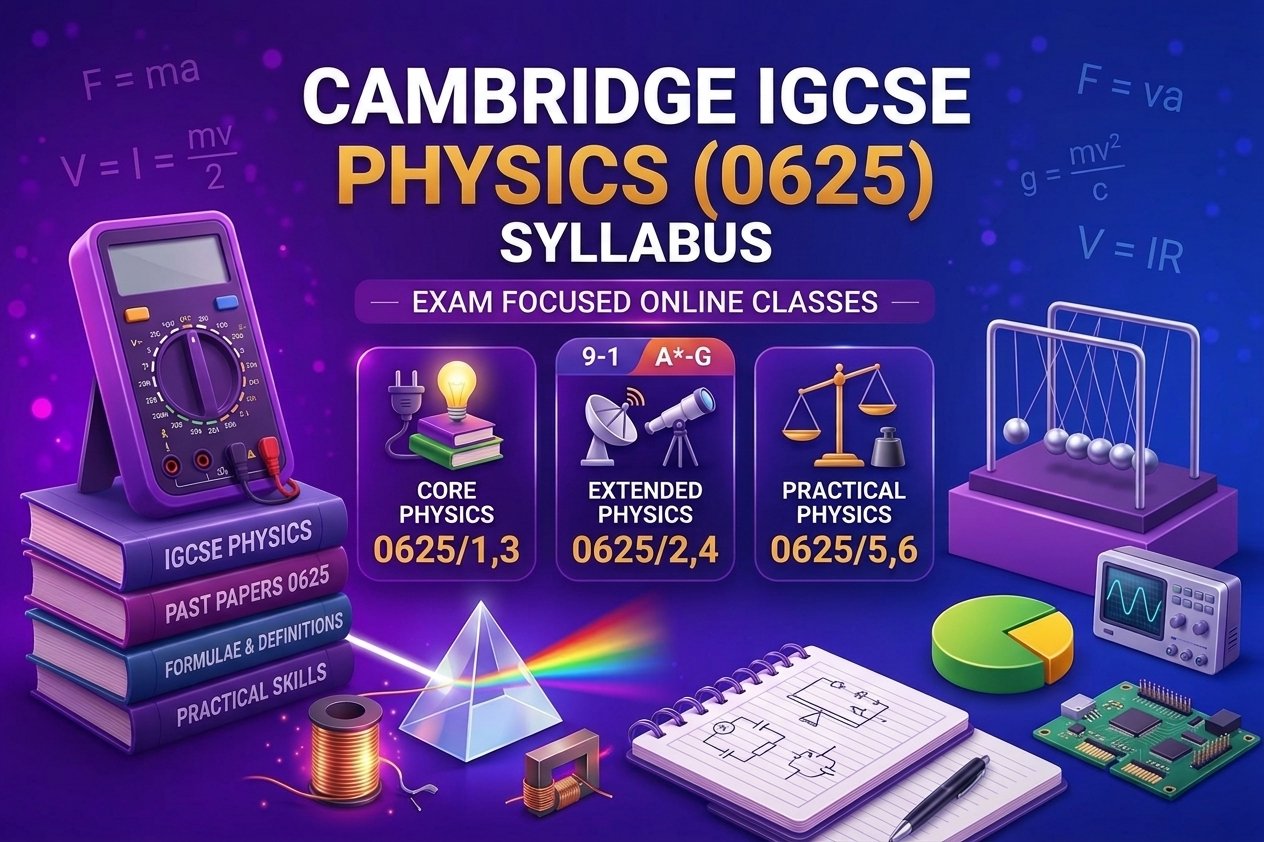
Cambridge IGCSE Physics (0625) Online Tuition & Course
Cambridge IGCSE Physics Syllabus (0625): Complete Exam Structure and Revision Guide
The Cambridge IGCSE Physics syllabus (syllabus code 0625, alongside the 9–1 graded variant 0972) is one of the most widely studied international science qualifications across Pakistan, the UAE, the UK, and global international schools. Designed by Cambridge Assessment International Education (CAIE) for learners typically aged 14 to 16 (Grades 9–10 / Years 10–11), the course builds foundational knowledge in classical and modern physics while developing quantitative problem-solving and experimental skills.
Whether you are a student mapping out your exam preparation or a parent comparing Core and Extended entry tiers, this guide breaks down the current Cambridge IGCSE Physics syllabus for the 2026–2028 examination cycle, explains the exact paper pattern, highlights recent assessment updates, and shares actionable study strategies from experienced physics educators.
Recent Syllabus Updates and Curriculum Changes (2026–2028 Cycle)
Before downloading past papers or buying revision guides, students and parents must verify which syllabus version applies to their exam session. Cambridge International introduced major structural and content updates starting in the 2023–2025 syllabus, and these remain fully active in the 2026, 2027, and 2028 examination series (with minor wording clarifications for 2026–2028):
-
Addition of Space Physics (Topic 6): Space Physics is a permanent, compulsory sixth core unit covering the Earth, the Solar System, orbital mechanics, stars, and the life cycle of the Universe (including redshift and the Cosmic Microwave Background Radiation). Older pre-2023 revision books omit this entire topic.
-
Removal of Certain Legacy Topics: Digital electronics (logic gates), barometers, manometers, and thermal capacity ($C = mc$ as a standalone concept separate from specific heat capacity) were removed during the 2023 overhaul and do not appear in current exams.
-
Updated Command Words and Electrical Symbols: Cambridge standardized its command words (such as calculate, deduce, explain, state, and suggest) and updated circuit symbols (such as the thermistor and variable resistor) to align with international IEC standards.
-
No Formula Sheet Provided: Unlike some UK domestic boards (such as Edexcel or AQA), Cambridge IGCSE Physics 0625 does not provide a formula sheet in the exam room. Candidates must memorize all required equations—though the value of gravitational field strength ($g = 9.8\text{ N/kg}$ or $9.8\text{ m/s}^2$) is specified on the front cover of the question paper.
Important Note on Syllabus Codes: Code 0625 uses the traditional A* to G grading scale (common in Pakistan, the UAE, and Asia), while code 0972 uses the 9 to 1 numerical grading scale (common in the UK and select Middle Eastern schools). The curriculum content, exam papers, and grade thresholds are identical.
Core vs. Extended IGCSE Physics: Choosing the Right Tier
The Cambridge IGCSE Physics syllabus is tiered so learners of varying mathematical confidence can demonstrate their understanding fairly:
-
Core Tier (Grades C to G / 5 to 1): Covers foundational concepts across all six topics. Suitable for students who find algebraic rearrangement or multi-step trigonometry challenging, or who do not plan to pursue A-Level Physics. The maximum achievable grade is C (or 5).
-
Extended Tier (Grades A* to E / 9 to 2): Includes all Core material plus Supplement content, which introduces deeper theoretical derivations, multi-step calculations, and higher-order analytical questions. Extended is required for students aiming for Grades A*, A, or B and serves as the essential bridge to Cambridge International AS & A-Level Physics.
Complete Breakdown of the Cambridge IGCSE Physics Syllabus Content
The 2026–2028 Cambridge IGCSE Physics syllabus is organized into six major subject blocks. Every student studies all six areas, with Extended candidates covering additional Supplement sub-topics within each unit:
-
Motion, Forces and Energy: Physical quantities and measurement techniques, kinematics (distance-time and speed-time graphs), mass and weight, density, forces (Hooke’s law, circular motion, turning effect/moments, centre of gravity), momentum (Extended), energy, work, power, and pressure.
-
Thermal Physics: Kinetic particle model of matter, thermal properties and temperature (thermal expansion, specific heat capacity, melting, boiling, evaporation), and transfer of thermal energy (conduction, convection, radiation).
-
Waves: General properties of waves, light (reflection, refraction, total internal reflection, thin converging/diverging lenses, dispersion), the electromagnetic spectrum, and sound (ultrasound, echoes, speed of sound).
-
Electricity and Magnetism: Simple phenomena of magnetism, electrical quantities (charge, current, electromotive force, potential difference, resistance, electrical working), electric circuits (series/parallel, potential dividers), electrical safety, and electromagnetic effects (electromagnetic induction, AC generators, transformers, DC motors).
-
Nuclear Physics: The nuclear model of the atom (protons, neutrons, electrons, isotopes), radioactivity (alpha, beta, and gamma emissions, radioactive decay equations, half-life, background radiation, safety precautions).
-
Space Physics: Earth and the Solar System (Earth’s rotation/orbit, seasons, phases of the Moon, planetary orbits, orbital speed equation $v = \frac{2\pi r}{T}$), stars and the Universe (the Sun as a star, life cycle of stars, galaxies, redshift, Hubble’s law, and the Big Bang theory).
Cambridge Physics Paper Pattern and Assessment Structure
To earn the IGCSE Physics qualification, candidates sit three examination papers during the May/June or October/November series (March series is also available in India). Your tier determines whether you take Paper 1 & 3 (Core) or Paper 2 & 4 (Extended), combined with one practical assessment (Paper 5 or Paper 6).
| Paper Component | Tier | Duration | Marks | Weighting | Question Format |
| Paper 1: Multiple Choice (Core) | Core | 45 minutes | 40 | 30% | 40 four-option multiple-choice questions |
| Paper 2: Multiple Choice (Extended) | Extended | 45 minutes | 40 | 30% | 40 four-option multiple-choice questions |
| Paper 3: Theory (Core) | Core | 1 hour 15 mins | 80 | 50% | Short-answer and structured questions on Core content |
| Paper 4: Theory (Extended) | Extended | 1 hour 15 mins | 80 | 50% | Short-answer and structured questions on Core + Supplement |
| Paper 5: Practical Test | All | 1 hour 15 mins | 40 | 20% | Hands-on laboratory tasks supervised in a school lab |
| Paper 6: Alternative to Practical | All | 1 hour | 40 | 20% | Written paper testing experimental planning, data, and graphs |
Paper 5 vs. Paper 6: Which Practical Option Do Schools Choose?
Both Paper 5 and Paper 6 carry an identical 20% weighting and evaluate the exact same experimental skills. Most private candidates and many international schools in Pakistan, the UAE, and online academies opt for Paper 6 (Alternative to Practical) because it requires no physical laboratory setup during exam day, while still testing apparatus selection, variable control, graph plotting, and error analysis.
How Students Are Evaluated: Assessment Objectives (AOs)
Cambridge examiners mark every paper against three strict Assessment Objectives:
-
AO1: Knowledge with Understanding (50% of total marks): Recalling definitions, laws, units, scientific vocabulary, and standard equations.
-
AO2: Handling Information and Problem Solving (30% of total marks): Applying physics principles to unfamiliar scenarios, rearranging formulas, interpreting graphs, and performing multi-step calculations.
-
AO3: Experimental Skills and Investigations (20% of total marks): Planning valid experiments, identifying independent/dependent/control variables, recording readings to appropriate precision, plotting lines of best fit, and evaluating sources of experimental error.
Common Challenges Students Face (and How to Overcome Them)
Having guided hundreds of IGCSE learners through the Cambridge IGCSE Physics syllabus, educators consistently see students lose marks not from a lack of intelligence, but from predictable exam-technique traps:
1. Memorizing Formulas Without Knowing Unit Conversions
In Extended Paper 4, a calculation mark is frequently lost before the physics even begins because mass was left in grams instead of kilograms, or time in minutes instead of seconds.
Fix: Write down every given value with its SI unit at the start of a calculation, convert immediately, and always include the final unit on your answer line.
2. Vague Explanations on “Explain” Questions
When a 3-mark question asks “Explain why the pressure of the gas increases when heated at constant volume,” writing “the particles move faster” earns at most 1 mark.
Fix: Use causal chains anchored in the mark scheme: (1) Particles gain kinetic energy and move faster → (2) They collide with the container walls more frequently and with greater force → (3) Force per unit area increases, so pressure increases.
3. Dropping Easy Marks on Paper 6 Graphs and Planning
Students often plot graphs that occupy less than half the grid, use awkward scales (like multiples of 3 or 7), or forget to state control variables in the 7-mark experimental planning question.
Fix: Always choose linear scales (1, 2, 5, or 10 units per major grid square) so plotted points cover more than 50% of both axes, draw a thin, sharp line or curve of best fit, and explicitly list at least two variables kept constant.
4. Underestimating Paper 2 Multiple Choice
Many Extended students focus exclusively on Paper 4 and treat Paper 2 as an afterthought—yet Paper 2 accounts for 30% of the final grade, with slightly over one minute per question.
Fix: Practice eliminating two distractors systematically and flag heavy calculation questions to revisit after securing quick conceptual marks.
Actionable IGCSE Physics Revision Tips
Follow a structured, three-phase revision plan in the months leading up to your exam series:
-
Audit Against the Official Syllabus Checklist: Print the topic-by-topic learning objectives from the official CAIE 0625 document. Color-code each statement green, amber, or red so your revision targets weak areas rather than topics you already enjoy.
-
Build an Equation & Definition Flashcard Deck: Since no formula sheet is provided, use active recall to test yourself daily on equations, SI units, and standard definitions (such as electromotive force, specific heat capacity, and half-life).
-
Practice Topical Past Papers Before Full Timed Mocks: Master one unit at a time using topical past papers from 2023 onward (so Space Physics and updated wording are included). Transition to full, strictly timed past papers 6 to 8 weeks before the exam.
-
Read the Examiner Reports: Cambridge publishes Examiner Reports after every series detailing the exact mistakes candidates made worldwide. Reviewing these alongside mark schemes trains you to think like an examiner.
How Structured Online Tutoring Supports IGCSE Physics Preparation
Independent revision works well for motivated learners, yet subtle misconceptions in topics like electromagnetic induction, lenses, or momentum can stall progress for weeks. Working one-on-one with an experienced specialist through personalized online IGCSE Physics tutoring helps students identify conceptual gaps early, master mark-scheme phrasing, and build confidence under timed exam conditions.
If you would like a clear baseline of where your child currently stands across all six syllabus units, book a free diagnostic physics assessment or explore our online IGCSE Physics tutoring program at Connected Learning Hub to receive a tailored study roadmap.
Cambridge IGCSE Physics 0625 vs. 0972: Key Differences and How to Choose
Parents and private candidates often wonder whether to register for syllabus code 0625 or 0972. Academically, the two codes are identical: they test the exact same Cambridge IGCSE Physics syllabus, use the same question papers on exam day, and follow equivalent grade boundaries.
The only difference lies in the grading scale—and choosing the right one depends on where your child plans to study next.
| Feature | Cambridge IGCSE Physics (0625) | Cambridge IGCSE (9–1) Physics (0972) |
| Grading Scale | Letters: A*, A, B, C, D, E, F, G | Numbers: 9, 8, 7, 6, 5, 4, 3, 2, 1 |
| Curriculum & Exam Papers | Identical (2026–2028 syllabus) | Identical (2026–2028 syllabus) |
| Top Grade Distinction | Single top tier (A*) | Splits the top tier into Grade 9 (exceptional) and Grade 8 (equivalent to low/mid A*) |
| Primary Regions | Pakistan, UAE, South Asia, Southeast Asia, global international schools | United Kingdom, select UK-curriculum schools in the Middle East and Europe |
| Local Equivalency Processing | Standard format for local equivalency boards (such as IBCC in Pakistan) | Accepted internationally, though local equivalency offices are more accustomed to A*–G |
Practical Trade-Offs to Consider
-
When 0625 (A*–G) is the better fit:
-
Familiarity with Local Equivalence Boards: In regions like Pakistan (IBCC) and across South Asia, the A*–G grading system is the standard benchmark for high school equivalence certificates and local university admissions.
-
School and Peer Alignment: Most international schools outside the UK enter candidates under 0625, meaning mock exam benchmarks, school transcripts, and teacher predictions align seamlessly with A*–G boundaries.
-
Broader Top-Grade Cushion: A solid A* performance earns the highest possible letter grade without splitting hairs between an 8 and a 9.
-
-
When 0972 (9–1) is the better fit:
-
UK University and Sixth Form Applications: The 9–1 scale mirrors the reformed GCSE grading system used in England, making it immediately intuitive for UK Sixth Forms and Russell Group admissions teams.
-
Greater Granularity at the Top: Because the old A* and A grades are split across three numerical levels (9, 8, and 7), a Grade 9 signals truly exceptional performance—helpful for students targeting ultra-competitive STEM pathways.
-
Considerations to Keep in Mind: If a student misses a Grade 9 by two marks and receives an 8, it still equals an A* under 0625, though some students feel psychological pressure chasing a 9 instead of an A*. Additionally, private candidates outside the UK should confirm that their local British Council exam center offers 0972 entries for that session, as 0625 has wider center availability globally.
-
Bottom Line for Parents: Both 0625 and 0972 carry identical global recognition from universities and employers. Choose 0972 if your child is applying primarily to UK institutions or wants Grade 9 differentiation; choose 0625 if you are in Pakistan, the UAE, or another international hub where A*–G is the local standard.
FAQs
1. Is a formula sheet provided in the Cambridge IGCSE Physics 0625 exam?
No. Cambridge International does not provide a formula sheet for IGCSE Physics 0625 (or 0972). Students must memorize all equations listed in the syllabus, although standard constants such as gravitational field strength ($g = 9.8\text{ N/kg}$) are printed on the front page of the exam paper.
2. What is the difference between IGCSE Physics 0625 and 0972?
Both codes follow the exact same Cambridge IGCSE Physics syllabus, use identical exam papers, and apply the same grade boundaries. The only difference is the grading scale: 0625 awards grades A* to G, whereas 0972 awards numerical grades 9 to 1.
3. Should my child take Core or Extended IGCSE Physics?
If your child is aiming for a Grade B, A, or A* (or grades 6–9) or plans to study Physics, Engineering, or Medicine at A-Level or university, they must enter the Extended tier (Papers 2 and 4). The Core tier (Papers 1 and 3) is capped at a Grade C (or grade 5).
4. How hard is Cambridge IGCSE Physics compared to other sciences?
IGCSE Physics is moderately challenging because roughly 30–40% of marks involve mathematical application, formula rearrangement, and graph interpretation. Students who are comfortable with basic algebra and consistently practice past papers typically find it highly predictable and rewarding.
5. What is Space Physics in the new IGCSE Physics syllabus?
Added as a mandatory sixth unit starting in 2023 and continuing through 2026–2028, Space Physics covers Earth’s rotation and seasons, the Solar System, orbital speed, the life cycle of stars, redshift, and evidence for the Big Bang theory.
6. Is Paper 6 harder than Paper 5 in IGCSE Physics?
Neither paper is harder; both are worth 20% of the final grade and test the same practical and analytical skills. Paper 5 requires performing live experiments in a school lab, while Paper 6 (Alternative to Practical) tests experimental design, readings, and graph plotting on paper.
Sources / References
-
Cambridge Assessment International Education (CAIE) – Syllabus: Cambridge IGCSE Physics 0625 (for examination in 2026, 2027 and 2028). Official curriculum framework, assessment objectives, and mathematical requirements. cambridgeinternational.org
-
Cambridge Assessment International Education (CAIE) – Syllabus: Cambridge IGCSE (9–1) Physics 0972 (for examination in 2026, 2027 and 2028). cambridgeinternational.org
-
Cambridge Assessment International Education (CAIE) – Cambridge IGCSE Physics 0625 Specimen Papers, Mark Schemes, and Examiner Reports (2023–2026 Series).
Should I take Core or Extended Physics?
This depends on your academic level, target grade and school/examination-centre guidance. Extended includes the Core and Supplement content and provides access to grades A*–G, while Core candidates are eligible for grades C–G.
Do I need strong Mathematics to study IGCSE Physics?
You should be comfortable with basic algebra, arithmetic, graphs and working with units. Physics itself also develops mathematical problem-solving skills throughout the course.
Do you prepare students for practical exams?
Do you prepare students for practical exams?
Do you provide past-paper practice?
Yes. Past-paper and exam-style questions can be incorporated into the course, particularly during the examination-preparation stage.
How many lessons do I need each week?
There is no fixed number that applies to every student. The appropriate frequency depends on your current level, examination date, target grade and syllabus coverage.
Features
- Group Class : 150AED
- 1:1 Class : 350AED
- Live Q&A Quizzes
- One to one attention
- Interactive Quizzes
- Past Paper Practice
- Small no of Group
- 10 classes per month
- Class duration more than 1.5 hour
Related programmes
Explore the updated Cambridge IGCSE Mathematics syllabus for 0580, 0980, 0607, and 0606. Compare Core vs Extended tiers, non-calculator exam rules, and revision tips.
- Group Class : 150AED
- 1:1 Class : 350AED
Focused AP Math (Precalculus, Calculus AB/BC, Statistics) tuition in Dubai & across UAE. American Curriculum specialists, exam prep, and mid-year transfer catch-up tracks. Book 2 free demo classes today!
- Group Class : 150AED
- 1:1 Class : 350AED
- Group Class : 150AED
- 1:1 Class : 350AED
Reviews
There are no reviews yet.